Beyond Angkor: The Hidden Theme Worlds of Siem Reap You’ve Never Heard Of
You know Siem Reap for Angkor Wat—but there’s way more beneath the surface. Beyond the temples, the city pulses with niche experiences: artisan villages, rice-field cycling trails, and silk farms where tradition meets touch. I was blown away by how much lies just off the tourist trail. This isn’t just a gateway to ancient wonders; it’s a living cultural playground. Let’s explore the themed worlds that make Siem Reap unforgettable. From handwoven silk to floating villages, from quiet cycling paths through emerald paddies to kitchens alive with the sizzle of lemongrass and kaffir lime, Siem Reap offers a deeper, more intimate kind of journey. It’s a place where travel becomes not just observation, but participation—a chance to connect with Cambodia’s soul in ways that linger long after the trip ends.
Reimagining Siem Reap: More Than Just Temples
For decades, Siem Reap has been synonymous with Angkor Wat—the vast, lotus-bud crowned temple complex that draws millions each year. It remains one of the world’s most awe-inspiring archaeological sites, a UNESCO World Heritage treasure that dominates postcards, travel brochures, and bucket lists. Yet, as global travelers grow more discerning, the demand for meaningful, immersive experiences has reshaped how people engage with destinations like this. The days of ticking off temple names from a checklist are gradually giving way to a richer form of travel—one rooted in connection, context, and curiosity.
This shift has unlocked a new identity for Siem Reap: not merely a launchpad for temple tours, but a vibrant cultural landscape filled with themed zones. These are distinct areas or communities that offer curated, authentic encounters—each with its own rhythm, craft, or way of life. Whether it’s learning to weave ikat silk, pedaling through rural hamlets on a bicycle, or sharing a meal in a stilt house above the water, these experiences invite visitors into the everyday heartbeat of Cambodia. They transform tourism from passive sightseeing into active storytelling.
The importance of this evolution cannot be overstated. Themed, community-based tourism supports sustainability by distributing economic benefits beyond the central tourist hubs. It empowers local families, preserves endangered crafts, and fosters pride in cultural heritage. For travelers, it delivers deeper satisfaction—a sense of having truly understood a place, not just seen it. In choosing these experiences, visitors help ensure that Siem Reap’s future remains as rich and resilient as its past.
The Artisan Enclaves: Craft Villages as Living Museums
Just a short drive from the bustling streets of central Siem Reap lie quiet villages where time seems to move to the rhythm of hands shaping earth, wood, and stone. These artisan enclaves function as living museums—places where traditional Khmer craftsmanship is not preserved behind glass, but practiced daily with skill and pride. Among them, Kompong Kdei stands out for its centuries-old tradition of sandstone carving. Here, sculptors use chisels and mallets much like their ancestors did, shaping intricate lotus motifs, guardian lions, and temple reliefs with patient precision. Visitors can watch, ask questions, and even try their hand at carving under gentle guidance.
Another gem is Kompong Loung, a riverside community known for its pottery. The scent of damp clay and wood smoke fills the air as potters spin handmade wheels and fire their wares in open kilns. The process is simple yet profound: clay is dug from the riverbank, shaped without molds, and sun-dried before being fired in rudimentary but effective ovens. The resulting jars, bowls, and water vessels are both functional and beautiful, bearing the subtle imperfections that mark them as human-made. Workshops here welcome guests to shape their own piece, an experience that fosters appreciation for the artistry behind even the most humble objects.
These villages are more than tourist attractions—they are vital centers of cultural continuity. Many younger Cambodians, influenced by urban migration and modern education, have moved away from traditional trades. Yet, through visitor interest and fair compensation, these communities are finding renewed value in their heritage. Income from workshops and craft sales supports families, funds children’s education, and helps maintain ancestral skills that might otherwise fade. Travelers who visit contribute directly to this revival, not through charity, but through respectful engagement and appreciation.
For the best experience, plan visits in the morning when artisans are most active and the light is soft. Always ask permission before photographing people, and consider purchasing a handmade item as both a keepsake and a gesture of support. Look for cooperatives or community-run centers, where profits stay within the village. These small acts of mindfulness ensure that tourism remains a force for dignity, not disruption.
Silk & Sustainability: The Revival of Cambodian Weaving
One of Cambodia’s most exquisite cultural treasures is its silk weaving, a craft nearly lost during decades of conflict but now experiencing a powerful resurgence. The intricate patterns of Cambodian ikat—where threads are tie-dyed before weaving to create blurred, dreamlike motifs—are unlike anything else in the textile world. This revival is led by organizations like Artisans d’Angkor, which partners with rural weavers to preserve techniques while ensuring fair wages and sustainable practices. Their workshops, located both in Siem Reap town and in surrounding villages, offer visitors a rare window into the entire silk-making process.
It begins with the silkworm. In quiet farms on the outskirts of town, mulberry leaves are fed to tiny caterpillars that spin golden cocoons. These are carefully harvested, boiled, and unraveled into fine filaments. The threads are then dyed using natural pigments—indigo for deep blues, lac insect resin for crimson, turmeric for sunshine yellow. Each color carries a story, rooted in local plants and traditional knowledge. The dyed threads are meticulously arranged and tied to create the ikat pattern, a process that can take days for a single piece.
Weaving itself is a meditative art. On wooden looms, women guide the shuttle back and forth, building the fabric row by row. The patterns often carry symbolic meanings: the hol motif represents the eye of the peacock, a symbol of protection, while the chan pattern echoes the lotus, a Buddhist emblem of purity. Visitors are often invited to sit at a loom and try a few passes, discovering how every movement must be precise to maintain the design’s integrity.
This revival is not just cultural—it’s environmental and ethical. Artisans d’Angkor and similar groups prioritize eco-friendly dyes, minimal waste, and organic mulberry farming. They train young Cambodians in the craft, ensuring the knowledge is passed on. For travelers, purchasing a piece of authentic Cambodian silk means supporting a chain of care—from farmer to weaver to steward of tradition. It’s a tangible way to honor the artistry and resilience of a people rebuilding their cultural identity, one thread at a time.
Cycling Through Culture: Rural Routes and Themed Trails
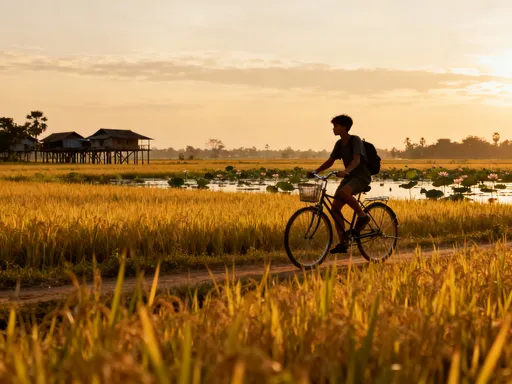
One of the most rewarding ways to explore Siem Reap’s hidden worlds is on two wheels. Cycling offers a pace that allows travelers to absorb the landscape, interact with locals, and access areas unreachable by car. A growing network of themed trails guides visitors through the countryside, each offering a unique perspective on rural life. The “Rice Field Ride” takes cyclists through endless emerald paddies, where water buffalo plow the soil and farmers in conical hats bend to plant seedlings. The “Village Life Loop” winds past wooden homes on stilts, schoolyards with laughing children, and roadside stalls selling sugarcane juice and grilled bananas.
Perhaps the most magical is the “Sunset Canal Trail,” a flat, shaded path along a quiet waterway. As the sun dips below the tree line, the sky blazes in shades of apricot and lavender, reflecting off the still water. Herons stand motionless at the banks, and the air fills with the chirping of crickets and the distant call to prayer. It’s a moment of quiet beauty, unscripted and unspoiled. These trails are carefully designed to minimize environmental impact while maximizing connection—routes avoid private property, follow existing paths, and prioritize safety and accessibility.
The benefits of slow travel by bicycle are profound. Unlike motorized tours, which rush from site to site, cycling allows for spontaneity—stopping to chat with a farmer, watching a family prepare dinner, or simply pausing to breathe in the scent of wet earth after a brief afternoon shower. It’s an invitation to be present. Many tour operators offer guided rides with bilingual local guides who share stories about village life, agricultural cycles, and seasonal festivals. Others provide GPS-enabled maps for self-guided adventures, ideal for independent travelers.
Rentals are widely available, with sturdy hybrid bikes, helmets, and repair kits included. The dry season, from November to March, offers the most comfortable conditions—cool mornings, clear skies, and firm dirt roads. During the rainy season, some trails may be muddy, but the landscape is lush and green, and the skies dramatic. Regardless of season, cycling in Siem Reap is more than transportation; it’s a journey into the heart of Cambodia’s rural soul.
Floating Worlds: Life on the Tonlé Sap’s Edge
The Tonlé Sap Lake, Southeast Asia’s largest freshwater body, is a world unto itself. During the dry season, it shrinks to a modest size, but with the monsoon rains, it swells dramatically, reversing the flow of its connecting river and flooding the surrounding plains. Along its edges, communities like Chong Kneas and Mechrey have adapted to this rhythm, building homes, schools, and markets on towering stilts. Some villages even float entirely, moving with the water level. These are not spectacles designed for tourists, but real communities living in harmony with a dynamic ecosystem.
Visiting these waterside settlements offers a humbling perspective on resilience and ingenuity. Houses are constructed from wood and corrugated metal, connected by narrow walkways. Children row to school in small wooden boats, and fishing nets hang like lace from porches. The diet revolves around freshwater fish—often dried, fermented, or turned into prahok, a pungent but essential ingredient in Cambodian cooking. Daily life is shaped by the lake: when water is high, boats replace roads; when it recedes, gardens spring up in the fertile silt.
Tourism here must be handled with care. In the past, some operators treated these villages as “human zoos,” rushing visitors through on crowded boats with little regard for privacy or dignity. Today, a growing number of ethical tour providers work directly with communities to offer respectful, educational experiences. These tours often include a stop at a floating school or community center, where visitors can learn about local challenges and initiatives. Some include a meal with a family, giving travelers a chance to share stories and express gratitude.
The goal is not voyeurism, but understanding. By choosing responsible operators—those that limit group sizes, hire local guides, and contribute fees to community projects—travelers help ensure that tourism supports, rather than exploits, these fragile ecosystems. A boat ride on the Tonlé Sap becomes more than a scenic excursion; it becomes a lesson in adaptation, sustainability, and the quiet strength of everyday life.
Taste as a Theme: Culinary Journeys Beyond the Market
In Siem Reap, food is not just sustenance—it’s a gateway to culture. The rise of culinary tourism has transformed the way visitors experience the region, shifting from restaurant hopping to immersive, hands-on learning. Cooking classes have become a staple of the travel itinerary, but the most meaningful ones go beyond the kitchen. They begin in herb gardens, where travelers pluck lemongrass, kaffir lime leaves, and holy basil. They include visits to local markets, where vendors display baskets of galangal, turmeric, and tiny eggplants. Some even venture into the countryside, where families forage for wild vegetables, mushrooms, and edible flowers.
At the heart of these experiences is a desire to understand context. Dishes like amok—a delicate fish curry steamed in banana leaves—are not just recipes; they are expressions of place and history. The use of prahok, while strong in scent, speaks to centuries of food preservation in a tropical climate. Banana blossom salad, crunchy and tart, reflects the ingenuity of using every part of the plant. By learning to prepare these dishes, travelers gain insight into Cambodian values: resourcefulness, balance, and harmony with nature.
The farm-to-table movement is quietly taking root in Siem Reap. Eco-conscious restaurants partner with smallholder farmers to source ingredients locally, reducing food miles and supporting sustainable agriculture. Some even grow their own herbs and vegetables in rooftop gardens or nearby plots. Visitors can tour these spaces, meet the growers, and see how food travels from soil to plate. This transparency fosters trust and appreciation, turning every meal into a story.
For travelers, choosing the right culinary experience matters. Look for schools that emphasize local ingredients, employ Khmer instructors, and limit class sizes to ensure personalized attention. Avoid those that feel overly commercial or disconnected from the community. The best classes end not with a certificate, but with a shared meal—laughter around a table, the clink of spoons, and the satisfaction of having created something authentic together. In that moment, food becomes connection.
Designing Your Themed Itinerary: From Curiosity to Journey
With so many rich experiences available, the challenge becomes not finding things to do, but weaving them into a coherent, fulfilling journey. The key is intentionality. Instead of trying to see everything, focus on a few themes that resonate—whether it’s craft, nature, food, or rural life. This allows for deeper engagement and more meaningful memories. A well-designed itinerary balances structure with flexibility, ensuring that travelers don’t just collect sights, but cultivate understanding.
Consider a sample three-day plan. Day one might begin with an early visit to Angkor Wat at sunrise—a must-see, done with reverence and reflection. In the afternoon, head to Artisans d’Angkor to explore silk weaving, followed by dinner at a farm-to-table restaurant. Day two could be dedicated to cycling: a morning ride through rice fields and villages, a stop at a pottery workshop, and a picnic lunch under a banyan tree. End with a gentle evening stroll through Pub Street, not for the bars, but for the street food and local energy. On day three, take a half-day boat tour to a Tonlé Sap community, followed by a hands-on cooking class in the afternoon.
Transportation in Siem Reap is straightforward. Tuk-tuks are widely available and affordable for short trips. For longer excursions, private drivers offer comfort and local knowledge. Bicycles can be rented daily or for multiple days. Time management is crucial—allowing at least half a day for each major experience ensures a relaxed pace. Avoid over-scheduling; leave room for unexpected moments, like a child offering a lotus flower or a farmer inviting you to try his mango.
Ultimately, themed travel transforms the act of sightseeing into storytelling. Instead of returning home with a list of places visited, travelers carry narratives—of a weaver’s hands, a shared meal, a sunrise over the water. These stories become part of their identity, shaping how they see the world. In choosing to explore beyond Angkor, visitors do more than enrich their own lives; they support a vision of tourism that honors people, preserves culture, and protects the planet. That is the true legacy of a journey well taken.
Conclusion
Siem Reap is not just a destination but a mosaic of themed experiences waiting to be discovered. By stepping beyond Angkor, travelers don’t just see Cambodia—they feel it, taste it, and carry its spirit forward. Choosing niche exploration supports communities, sustains traditions, and creates more meaningful memories. The real wonder isn’t just in the stones of the past, but in the living culture all around. Where will your journey take you next?